

If you’re researching New Hampshire tax rates, you’re likely considering relocating, retiring, or investing in the Granite State. One of the biggest reasons people move to New Hampshire is its unique tax structure.
Unlike most states, New Hampshire has:
- No state income tax on wages
- No statewide sales tax
- No tax on Social Security
- No estate or inheritance tax
Understanding New Hampshire tax rates can help you determine whether moving here makes financial sense for your situation.
Table of Contents
- Overview of New Hampshire Tax Rates
- Does New Hampshire Have Income Tax?
- Is There Sales Tax in New Hampshire?
- Property Taxes in New Hampshire
- Retirement and Investment Taxes
- Business Taxes in NH
- How NH Compares to Massachusetts and Maine
- Is New Hampshire a Tax-Friendly State?
- FAQ About New Hampshire Tax Rates
Overview of New Hampshire Tax Rates
When people search for New Hampshire tax rates, they’re usually asking:
- Does NH have income tax?
- How high are property taxes?
- Is NH better than Massachusetts for taxes?
- Is New Hampshire good for retirees?
The short answer: New Hampshire has one of the most unique and often favorable tax structures in the Northeast.
However, the tax burden depends on your income level, property ownership, and spending habits.
Does New Hampshire Have Income Tax?

One of the most significant advantages of New Hampshire tax rates is:
0% Tax on Earned Income
New Hampshire does not tax:
- Wages
- Salaries
- Commissions
- Self-employment income
The former Interest & Dividends tax has been fully phased out, meaning most personal investment income is no longer taxed at the state level.
For high-income earners moving from states like Massachusetts (flat income tax) or Maine (progressive income tax), this can represent substantial annual savings.
Is There Sales Tax in New Hampshire?
Another major reason people relocate is:
0% Statewide Sales Tax
New Hampshire has:
- No state sales tax
- No local sales tax
This means no tax on:
- Retail purchases
- Furniture and appliances
- Vehicles
- Boats
- Building materials
For families, homeowners, and investors, this makes major purchases significantly more affordable compared to neighboring states.
Property Taxes in New Hampshire
While New Hampshire tax rates are favorable in many areas, the state relies more heavily on property taxes to fund local services.
How Property Taxes Work in NH
Property tax rates vary by town and are expressed per $1,000 of assessed value.
Example:
A $500,000 home in a town with a $20 per $1,000 tax rate would pay approximately $10,000 annually in property taxes.
Although property taxes are above the national average, many residents still benefit overall due to:
- No income tax
- No sales tax
- No retirement tax
For many households, the overall tax burden remains competitive.
Retirement and Investment Taxes in NH
Retirees frequently research New Hampshire tax rates before relocating.
New Hampshire does not tax:
- Social Security benefits
- Pension income
- 401(k) withdrawals
- IRA distributions
There is also:
- No estate tax
- No inheritance tax
For retirees with significant retirement income, New Hampshire can be one of the most tax-efficient states in the Northeast.
Business Taxes in New Hampshire
New Hampshire does not tax personal income, but it does have:
- Business Profits Tax (BPT)
- Business Enterprise Tax (BET)
These apply to certain business entities operating within the state.
However, for entrepreneurs and small business owners, the absence of personal income and sales tax can offset business-level taxation.
How New Hampshire Tax Rates Compare to Massachusetts and Maine
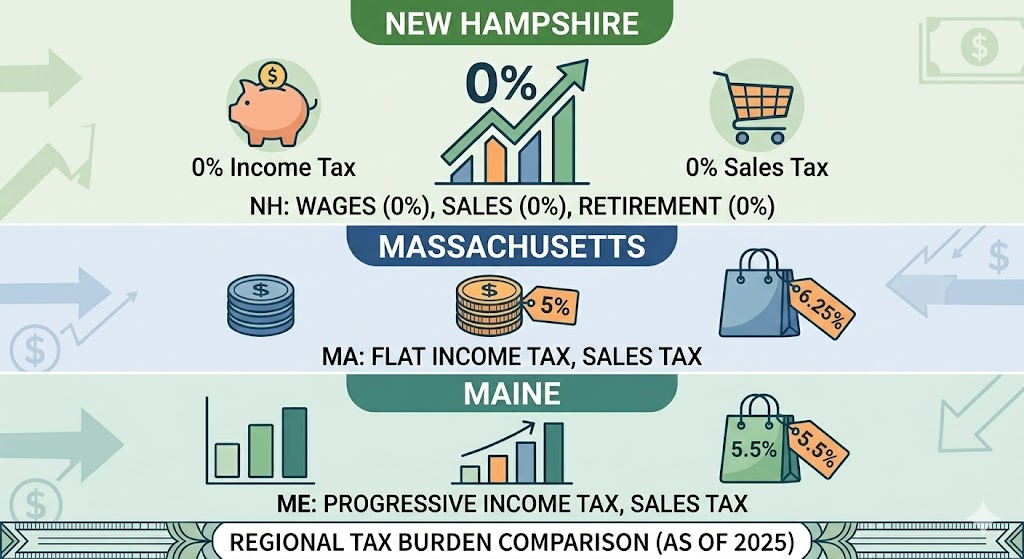
Massachusetts
- Flat state income tax
- State sales tax
- Lower property taxes (on average)
- Tax on short-term capital gains
Maine
- Progressive income tax
- State sales tax
- Moderate property taxes
Compared to both states, New Hampshire tax rates are particularly attractive to:
- High-income earners
- Business owners
- Retirees
- Remote workers
This is why southern New Hampshire has seen consistent inbound migration.
Is New Hampshire a Tax-Friendly State?
When evaluating New Hampshire tax rates, the answer depends on your profile.
NH is particularly advantageous if you:
- Earn a high salary
- Are retired with investment income
- Make large retail purchases
- Prefer predictable property tax structures
It may be less advantageous if you:
- Own multiple high-value properties
- Operate property-heavy businesses
Overall, New Hampshire consistently ranks among the most tax-friendly states in national comparisons.
Relocating to New Hampshire: What to Consider
If you’re exploring New Hampshire tax rates as part of a relocation decision, also evaluate:
- Local property tax differences by town
- School district funding
- Municipal services
- Commuter access to Massachusetts
- Waterfront vs non-waterfront property assessments
Every town in NH has a slightly different tax structure, which is important when purchasing real estate.
If you’re considering a move, reviewing town-specific data before buying can make a significant financial difference.
FAQ About New Hampshire Tax Rates
Does New Hampshire have state income tax?
No. There is no tax on wages or earned income.
Is there sales tax in NH?
No. New Hampshire has no statewide or local sales tax.
Are property taxes high in New Hampshire?
Property taxes are above the national average but vary significantly by town.
Does NH tax retirement income?
No. Social Security, pensions, and retirement withdrawals are not taxed at the state level.
Is NH better than Massachusetts for taxes?
For many wage earners and retirees, yes — particularly due to no income or sales tax.
Final Thoughts on New Hampshire Tax Rates
New Hampshire tax rates are one of the primary reasons people relocate from neighboring states. While property taxes are higher than the national average, the absence of income, sales, and retirement taxes creates a highly competitive overall tax structure.
If you’re considering moving to New Hampshire, understanding both state-level and town-level tax implications is critical before purchasing property.